
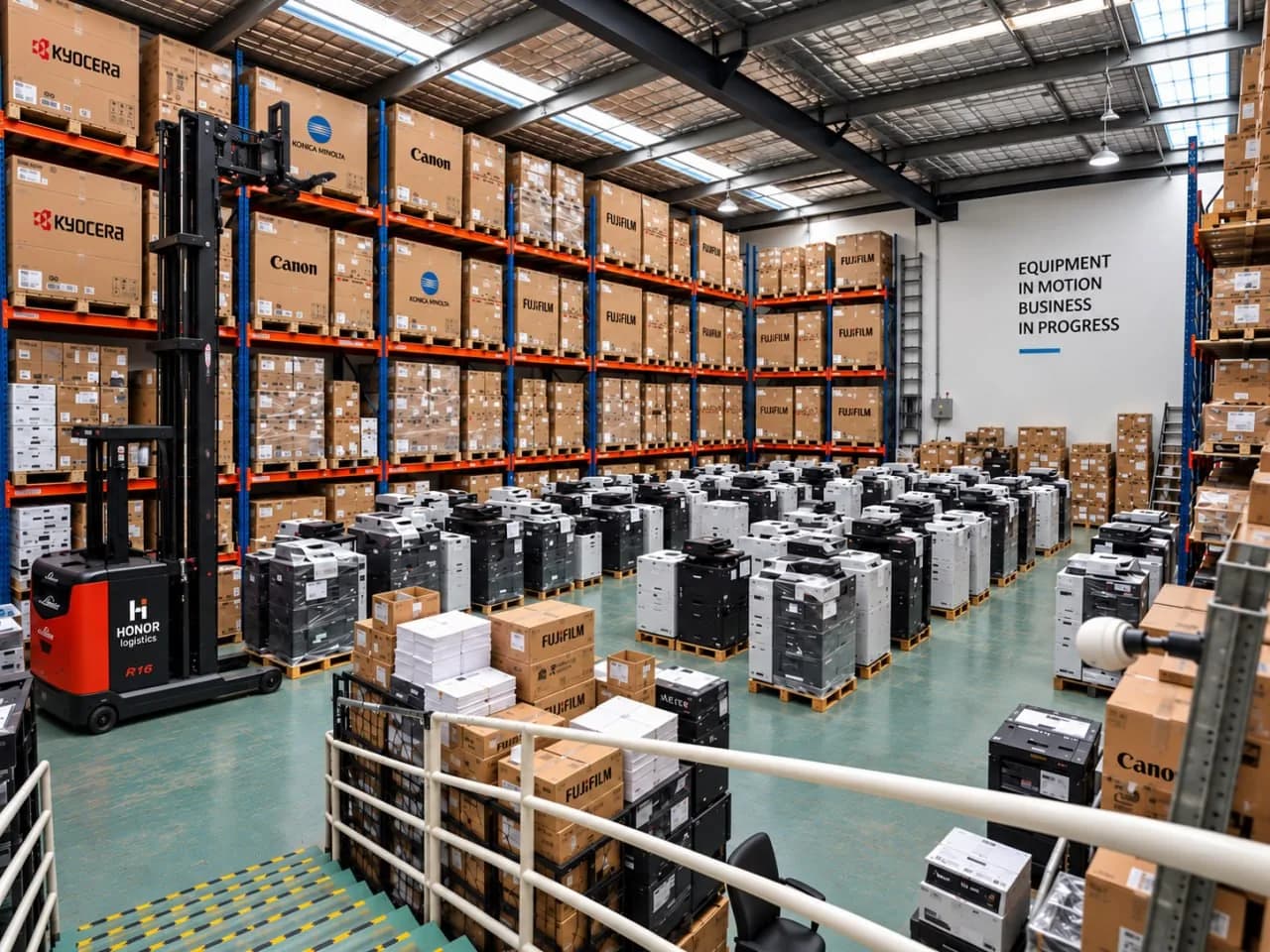
Production print logistics.
Production print equipment is not moved off a price list. It is surveyed, sequenced and planned — because on this class of machine the access, the floor and the reinstatement are the job, and the drive between two addresses is the easy part.
- COVERAGE
- NSW · ACT
- FACILITY
- MORTDALE
- HANDLING
- TAIL-LIFT · STAIR CLIMBER
An office printer is freight. A production machine is a project.
A desktop MFD is picked up, driven and wheeled into place. The failure mode is a scratch. Production print equipment fails differently: it does not fit the lift, the floor will not take it on a pallet jack, it has to come apart to leave the room it is in, and the part of the job that decides whether the move succeeds happened three weeks earlier, on a survey.
The second difference is that the machine is earning money. Every hour it is not printing is an hour of production someone has already sold. That makes the sequence — when it comes down, when it travels, when it goes back together, who signs it off — worth more than the transport line on the quote.
So this work is scoped from a site survey rather than from an equipment list, and the plan is written backwards from the hour the machine has to be printing again.
The work, itemised.
Everything below is the method Honor already runs on rollouts, applied to a class of equipment where the planning carries more of the weight.
Site survey before the quote
Both ends are looked at before a price is written — access route, lift, door widths, floor and the position the machine has to land in. A quote written without that is a guess with a number on it.
Access and route planning
Dock windows, lift bookings, building access and out-of-hours approvals arranged before the day, so the crew is not negotiating with a building manager while a machine sits on a tail lift.
Planned transport
Moved on its own scheduled run rather than consolidated with general freight, and logged out of the facility against the docket the same way every other asset is.
Staging at Mortdale
Where the receiving site is not ready, the machine is held at the Mortdale facility with a pallet location and a days-in-storage count against it, rather than sitting in a corridor at either end.
Positioning and placement
Set in the position agreed on the survey, not the nearest clear floor. Where the room has a services constraint — power, extraction, clearance for service access — that is settled on the survey rather than discovered on the day.
Reinstatement and sign-off, in-house
Honor runs the whole chain itself — receiving, unboxing, run-up, configuration, delivery and install. There is no handover to a third party in the middle of it, and no gap in the record where one would be. The move ends with a signed sheet naming the person who took the machine on, its serial and the date.
Planned backwards from the hour it has to print again.
Seven steps. The first two are where a production print move is won or lost, and they happen before anything is touched.
Survey and plan
Both sites walked, access measured, the route agreed and the constraints written down. This is the deliverable that everything after it is scheduled against.
Sequence and book
The production window, the docks, the lifts and the crew are booked to one plan, with the order of operations agreed in writing before the date is confirmed.
Prepare
The machine is prepared for transport and anything removed to get it out of the room is logged as it comes off, so it can be put back the way it came apart.
Collect and log
Logged out under custody with the serial recorded at pickup, the same as every other asset Honor moves.
Transport or stage
Straight to the receiving site on a planned run, or held at Mortdale with a pallet location until the room is ready.
Position
Placed in the agreed position, levelled and squared to the services it needs. Access clearances for future servicing are part of the placement, not an afterthought.
Reinstate and sign off
Reassembled, checked against the record taken at the other end, and signed for by name, role, date and serial.
What sits inside this scope.
Categories, not brands. Honor does not claim a manufacturer relationship it does not hold, and naming makes and models is a client decision rather than a marketing one.
Production printers
High-volume commercial print devices that will not travel or install like an office fleet machine.
Every make and model
Honor services A4, A3 and wide-format equipment across every manufacturer, rather than holding a short list of machines it will take on.
Finishing equipment
Folders, binders, cutters and inline finishing that travels with the machine and has to be positioned in the same run.
Where the scope ends
A4, A3 and wide format is the ceiling. Press-class digital production equipment above that sits outside what Honor takes on, and saying so here is cheaper for both sides than finding it out on a survey.
What buyers ask us.
- Do you relocate production print equipment?
- Yes, across every make and model of A4, A3 and wide-format equipment. Moves are scoped from a site survey rather than from an equipment list, because on this class of machine the access and the reinstatement decide the job.
- Who recommissions the machine once it is in position?
- We do. Honor runs the full chain in-house — receiving, unboxing, run-up, configuration, delivery and install — so there is no point in the job where it is handed to a third party and no gap in the record where that handover would sit. One contract, one crew, one set of paperwork.
- What handling equipment do you use for machines this size?
- Hydraulic tail-lift fitted vehicles and stair climbers, plus the rest of the gear a given job needs. Honor holds what it takes to move A4, A3 and wide-format equipment without hiring it in, which is why the survey can commit to a date rather than to an equipment booking.
- Can you hold the machine between sites?
- Yes. It is held at the Mortdale facility with a pallet location and a days-in-storage count against it, and logged in and out the same way as any other asset. That is the usual answer when a receiving room is not finished on the date the old site has to be vacated.
- What insurance covers equipment of this value in transit?
- NTI Carriers Protect goods-in-transit cover, and $20,000,000 public and products liability. Certificates of currency are available on request, which is the form procurement needs them in.
The operations behind this work.
This is an equipment class, not a department. These are the parts of Honor that actually run it.
The rest of what Honor moves.
How can we help you?
Tell us the sites and the machine count. We will come back with a scope, a schedule and a price, not a brochure.
Pick the one closer to your job and we will tailor the response.
Hours / Mon–Fri, 7:30am – 4pm
After hours / Available by arrangement