
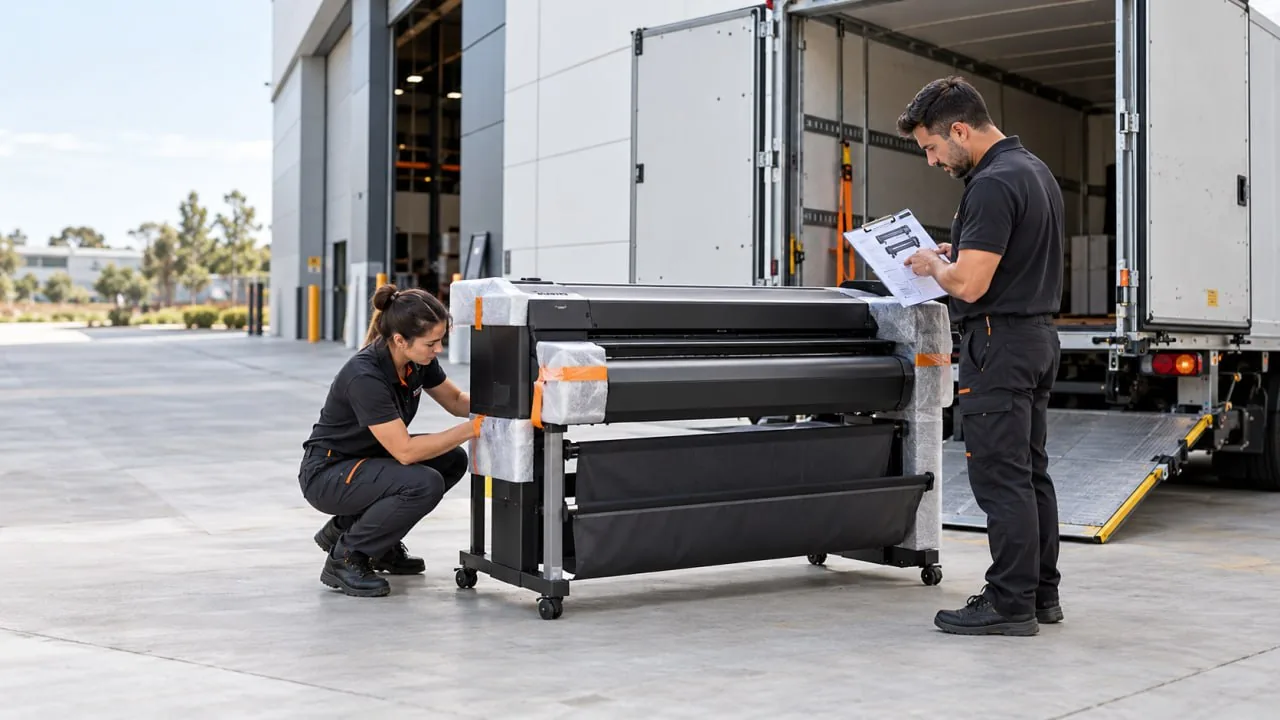
A printer, server or diagnostic device can arrive without visible damage and still fail its next job. A loose accessory, an unrecorded serial number, a blocked delivery path or a machine tilted against the manufacturer’s instructions can turn a straightforward delivery into downtime. That is why sensitive freight logistics starts before the vehicle arrives and continues until the equipment is positioned and handed over.
At Honor Logistics, we support businesses across NSW and the ACT with planned transport, warehouse staging and technical installation support for sensitive equipment. This guide explains what to check when organising a move, with particular attention to multifunction printers, production print systems and wide format devices.
What is sensitive freight logistics?
Sensitive freight logistics is the planned handling and movement of equipment that needs more care, control or documentation than ordinary boxed freight. The requirement may come from fragile components, high asset value, weight and access constraints, operational downtime, or the need to account for every device at handover.
Examples include multifunction printers (MFDs), production printers, wide format printers, IT equipment and selected healthcare devices. The right approach depends on the specific machine and site. It can involve an access survey, protective wrapping, a suitable vehicle and tail lift, asset and serial recording, controlled placement, and coordination with the people responsible for commissioning.
Five checks before moving sensitive equipment
1. Identify the exact asset and its transport requirements
Record the make, model, serial number, dimensions, weight and attached modules. Confirm whether trays, finishers, stands, media rolls or other accessories travel attached or separately. Check the manufacturer’s transport guidance and whether an authorised technician must shut down, lock, drain or prepare the device. A logistics crew should not improvise a decommissioning procedure for an ink system or a specialist machine.
2. Survey the complete route, not just the addresses
Check loading bays, vehicle height limits, stairs, ramps, thresholds, lifts, corridors, door widths and the final position. Confirm who books access and whether the building requires a delivery window, lift protection or a site induction. Where stairs or tight turns are involved, decide on the handling method before quoting or dispatching the crew.
3. Plan protection and loading around the machine
Protect screens, panels and vulnerable components, secure detachable items and keep the equipment within the handling limits set by its manufacturer. For suitable heavy equipment, a hydraulic tail lift allows controlled vehicle loading. A3 multifunction devices with built-in casters should move on those casters during normal site movement, with their packaging and vehicle restraint planned separately. The method for a wide format machine may differ considerably from an office MFD.
4. Keep the asset record consistent
Match serial numbers and item counts at collection and delivery. Record the location, responsible contact, accessories and any visible pre-existing condition. For swaps and multi-site rollouts, a clear handover record helps the supplier, customer and installation team reconcile what was removed and what was installed. Where a device stores customer data, agree on the party responsible for data protection and any required erasure before collection.
5. Define what “complete” means
Delivery can mean kerbside receipt, placement in the room, unpacking, assembly, connection or a documented test. State the scope in the job brief. If the move includes installation or configuration, coordinate site readiness, power, network access and the client’s IT contact. A machine that reaches the building but cannot be used may still leave a rollout unfinished.
Wide format printer logistics needs its own plan
Wide format printer logistics calls for model-specific preparation. Plotters and other large format devices can have long frames, sensitive printheads, ink systems, stands and media handling assemblies. Their size can also make a lift or doorway the deciding factor, even when the vehicle and crew are suitable.
Before collection, confirm the precise model and manufacturer guidance. Ask whether ink or other fluids require a technician-led shutdown or transport procedure, whether components should be locked or removed, and how much tilt is permitted. Measure the machine in its transport configuration as well as the access route. Arrange a ramp or other approved method if there are steps; do not assume a machine can be tipped to make it fit.
For a relocation or supplier return, the brief should also say who decommissions the printer, who packs its accessories, who receives it and whether the destination needs placement or technical recommissioning. These details help protect the device and avoid delays at the other end.
From warehouse staging to handover
Some jobs are best handled as a sequence rather than a single trip. Equipment may arrive at a warehouse for checking, labelling and staging before a scheduled rollout. Machines can then be dispatched by site, installed in an agreed order and matched against an asset list. Existing equipment may need to be disconnected, collected and returned to the supplier or directed to an agreed end-of-life process.
Honor Logistics can coordinate transport, warehouse staging, printer and MFD delivery, swaps, relocations and technical installation support across NSW and the ACT. The scope for each project is agreed in advance, including any technician, IT or specialist decommissioning work required.
What to include when requesting a quote
Send the collection and delivery addresses, equipment make and model, quantity, approximate dimensions and weight, preferred dates, site access details and the service required at each end. Mention stairs, lift dimensions, restricted loading zones and any manufacturer transport instructions. For a rollout, add a site list and the expected handover or serial reporting format.
The more complete the brief, the easier it is to plan the correct crew, handling method and schedule.
Frequently asked questions
Is sensitive freight the same as fragile freight?
Fragility is one factor. Sensitive freight may also require planned access, controlled handling, asset tracking, technical preparation and a defined handover because the equipment is valuable or operationally important.
Can a wide format printer be transported with ink installed?
That depends on the model, ink system, route and manufacturer instructions. Have the supplier or an appropriately qualified technician confirm the required shutdown or transport preparation before the move. Avoid assuming that a short journey makes tilt or ink movement harmless.
Do you move printers outside Sydney?
Honor Logistics supports projects across NSW and the ACT, subject to the equipment, site access and agreed scope. Provide the route and machine details for a tailored quote.
Can delivery and installation be coordinated together?
Yes. The job can be planned around placement and technical installation support, with any client IT involvement and manufacturer-specific tasks confirmed before booking.
Plan your next equipment move
Moving a sensitive asset successfully means knowing the machine, the route, the people and the handover requirements. If you are planning a single printer relocation, a wide format return or a multi-site equipment rollout, request a quote from Honor Logistics with the equipment and access details. We will help define the right movement and delivery scope.